
Gelato and panettone
04/12/2025
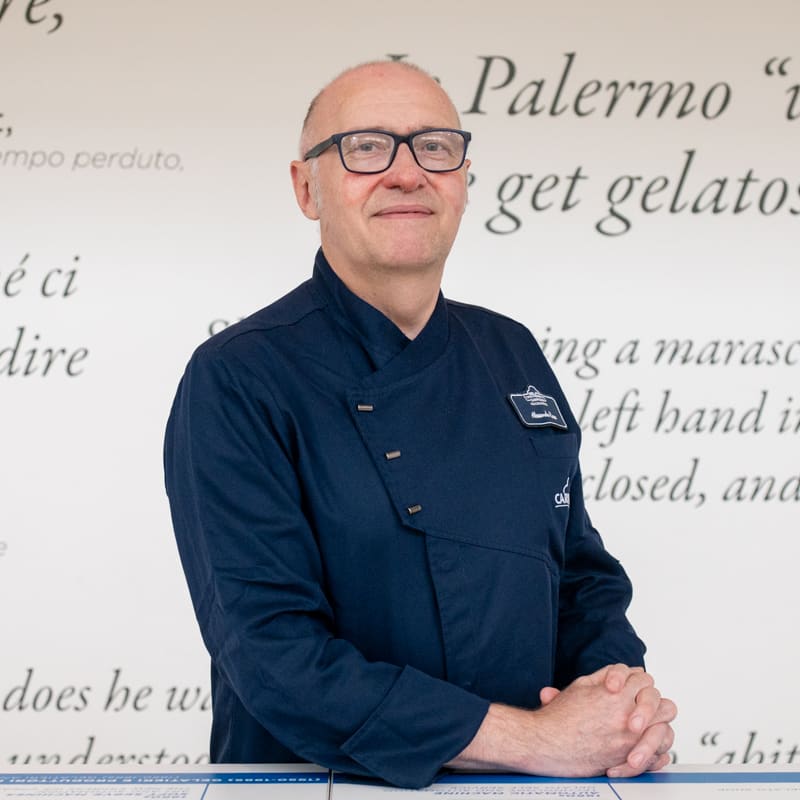
Today, panettone is no longer a dessert reserved exclusively for the Christmas holidays, but has become a year-round product with numerous seasonal variations. In December, many gelato shops offer it as an alternative to gelato, or filled with gelato. Alessandro Racca, pastry chef and senior lecturer at Carpigiani Gelato University, shares his experience pairing gelato and panettone.
Filling panettone is an excellent way to pair gelato with a traditional holiday treat. The challenge is that these two products have different serving temperatures, so a few tricks are needed to enjoy them together. People want panettone with gelato—so what should the gelato maker do? One option is to fill the panettone with *panettone-flavored* gelato, prepared using the panettone obtained by hollowing out the center. The recipe can be customized by adding cremino inserts, such as pistachio, orange, or hazelnut, to enrich the gelato. Before filling, it’s important to moisten the panettone with syrup to prevent the dough from hardening, since its high fat content causes it to firm up in the cold. This would also compromise its flavor profile. For this reason, it’s essential to explain to customers how to serve it once they get home. Ideally, the panettone should be heated whole in the oven at 180°C for 3–4 minutes, allowing the exterior to brown slightly while the interior, with the gelato, remains largely unaffected by the heat, creating a pleasant contrast.
A second option for offering panettone in a gelato shop is to serve it as a pairing: the panettone is enjoyed alongside the gelato, possibly enriched with creams. This is also an appealing way to present it, as a slice of panettone can be paired with three different creams—for example, vanilla, orange, and hazelnut.
For those who wish to make a filled panettone, it is advisable to use insulated boxes made of high-density polystyrene, which are very thin yet retain temperature well. Gelato makers should also provide instructions on how to best serve and enjoy the product. If the panettone is not heated in the oven, it can be left at room temperature so that both components reach the ideal temperature.
To fill a panettone, you can prepare orange gelato or an orange sorbet, which is refreshing and balances the richness of the panettone’s fat content. Alternatively, you can choose warmer flavors such as cream, pistachio, chocolate, or hazelnut. As mentioned above, panettone can also be used as an ingredient in gelato: the gelato maker can prepare a “panettone” flavor to serve during the winter months and, if desired, create small, delicious individual portions. You can let your creativity run free by placing the gelato in a silicone panettone-shaped mold—now widely available—or by using polycarbonate molds (typically used for chocolate) and applying a light chocolate coating to ensure the product releases easily, making it suitable for panettone gelato.
Another way to create a unique product is to fill the panettone with the creams mentioned above. The creams can be fresh or anhydrous, meaning they can be stored outside the refrigerator. In this case, the gelato maker can fill the panettone and sell it ready-made, or offer it along with small piping bags filled with different creams for customers who prefer to fill it themselves. Filling it at home can be enjoyable for some customers, though not everyone appreciates this format; some prefer the panettone to be filled directly by the shop.
In conclusion, panettone in gelato shops is an excellent ally during the winter months, when customers—especially in Italy—tend to consume less take-out gelato. It helps increase sales even in the low season and allows the creation of unique products and pairings.

Comments (0)